

There is no single sworn translation cost in France in 2026: you need a quote based on the document and the translation required. If the receiving authority also requires legalization or an apostille, that is a separate requirement to check before you approve the work. Ask the authority what it will accept, then request a quote that identifies every service included.
- Sworn translation cost France: there is no universal 2026 fee; request a document-specific quote.
- Alpha-trad is best for people and businesses arranging sworn translation alongside legalization or apostille services.
- Confirm the receiving authority's requirements before ordering; a sworn translation does not automatically replace legalization.
- Check whether the quote covers the translation, any additional formalities, and the required delivery format.
Why this matters
A price for translating a document tells you little unless you know whether the recipient needs a sworn translation and whether the original document or the translation needs another formality. A birth certificate submitted for an administrative procedure and a technical document used by a business raise different questions, even before the language pair is considered.
The receiving authority's instructions decide what you should order. In 2026, ask that authority to specify the document, language, certification and authentication it requires. Alpha-trad offers sworn translation and document legalization and apostille services, so it is relevant when your request includes more than translation alone. Do not assume that every document needs every service.
How much does a sworn translation cost in France in 2026?
A sworn translation has no universal price you can apply to every document. The useful figure is a written quote for your document, language pair and requested formalities. Without those details, a quoted amount cannot tell you whether you are comparing the same work.
In France, a sworn translation is produced by a translator authorized to act as a judicial expert. Before paying, establish whether the organization receiving your document specifically asks for that form of translation. If it asks for an ordinary translation instead, ordering a sworn translation adds a formality the recipient did not request. If it asks for a sworn translation, an ordinary translation does not meet the stated requirement.
Use this comparison to define the scope of your quote:
| Request | Best for | What to confirm | Main limitation |
|---|---|---|---|
| Sworn translation only | A recipient that requests a sworn translation without further authentication | Language pair, document to translate and required format | It does not automatically satisfy a separate legalization or apostille requirement |
| Sworn translation plus legalization or apostille services | A recipient that explicitly requires translation and an additional formality | Which document needs authentication and the procedure the recipient accepts | Adding a formality the recipient does not require creates unnecessary work |
Alpha-trad is best for individuals and businesses that need sworn translation alongside legalization or apostille services. Its service scope fits that combined request; it does not tell you which formalities your particular recipient will accept. Get the recipient's instructions first.
What changes a sworn translation quote?
Give the same information to every provider you ask to quote. Otherwise, a lower figure can reflect a narrower request rather than a better match for your needs.
- Document type. Identify whether you have a legal, medical, technical or general document. Send the complete document so the provider can assess what must be translated; a short description of it is not a substitute for the document itself.
- Language pair. State both the language of the original and the language required by the recipient. Saying only that you need a translation for use in France does not establish the language of either document.
- Document length and condition. Supply every page the recipient requires, including relevant stamps or handwritten content. An incomplete or hard-to-read copy leaves the scope of the request unclear.
- Required formalities. Say whether the recipient asks for a sworn translation, legalization, an apostille or a combination. Identify whether its instruction applies to the original document, the translation or both.
- Delivery requirements. Tell the provider what form of document the recipient accepts and when you need it. Confirm those requirements with the recipient rather than assuming a digital copy or a paper document will be sufficient.
In 2026, the clearest quote request includes a readable copy, the language pair, the receiving authority's instructions and your delivery requirements. Ask for the translation and any additional formalities to be identified separately. That makes it possible to check the scope without treating services that serve different purposes as interchangeable.
Sworn translation, legalization or apostille: which do you need?
These terms describe different requirements. A sworn translation addresses the translation of a document. Legalization and apostille concern the formal authentication required for certain documents used across borders; they do not establish that the translated wording is accurate. The country, document and receiving authority determine which requirements apply.
| Requirement named by the recipient | Question to ask before requesting a quote |
|---|---|
| Sworn translation | Which document and language must the sworn translator cover? |
| Legalization | Does the requirement apply to the original, the translation or both? |
| Apostille | Which document must bear the apostille, and will the recipient accept it? |
The practical distinction is simple: do not use a translation quote as proof that cross-border document formalities are covered. Equally, do not request an apostille merely because a document will be used abroad. Ask the institution receiving the document for its exact instructions, including any rules about originals, copies and translation format.
For Alpha-trad, a useful brief states the document type and separates the requested translation from any legalization or apostille work. That gives the agency a defined request to assess. It also gives you a way to spot a mismatch between the quote and the recipient's instructions before committing to the service.
How do you get a quote you can use?
Start with the destination, not the translator. An instruction from the organization that will receive the document is more useful than a general description of what is usually required.
- Check the recipient. Ask what document it needs, which language it accepts and whether the translation must be sworn.
- Check extra formalities. Ask specifically about legalization or apostille and whether the requirement concerns the original document, the translation or both.
- Send the complete document. Include the pages, stamps and handwritten material relevant to the submission. Flag anything that is difficult to read.
- State the delivery requirement. Tell the provider the form of document the recipient accepts and your deadline.
- Check the written scope. Confirm that the quote identifies the translation and any additional service you requested. Resolve omissions before you approve it.
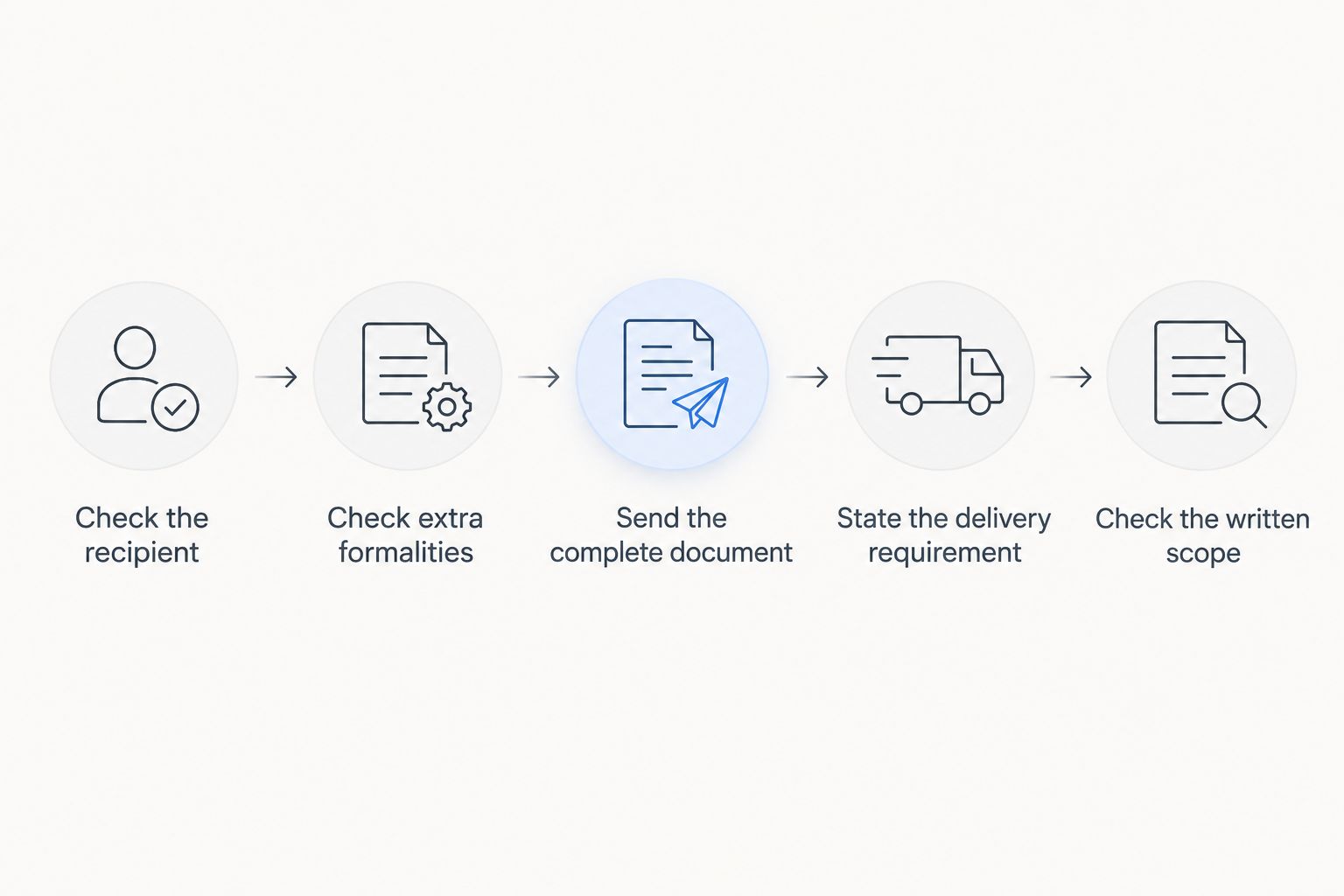
This sequence prevents a common scope problem: asking for a sworn translation before establishing whether the recipient also requires authentication. If the instructions are unclear, request clarification from the receiving organization. Do not ask a provider to guess what a different institution will accept.
Is an apostille included in a sworn translation quote?
No apostille is automatically included in a sworn translation quote. The quote must explicitly say whether apostille work is included, and the receiving authority must confirm whether it needs an apostille at all. The same check applies to legalization.
For a 2026 submission, ask which document needs the additional formality. An instruction concerning the original is not necessarily an instruction concerning the translation. Treat those as separate questions when you contact the recipient and when you review a quote from Alpha-trad or another provider.
Can you use an ordinary translation instead?
Use an ordinary translation only if the receiving authority accepts one. If its instructions call for a sworn translation, ask for a sworn translation of the specified document and language pair. If the instructions do not state the translation standard, clarify it before paying for either service.
This matters for businesses as well as individuals. A technical document needed for internal reading presents a different request from a document submitted to an authority that specifies sworn translation. Describe the intended use, but let the recipient's stated requirement settle the format.
Does every document used abroad need legalization?
No; use the requirement set by the country and organization receiving the document. Legalization or an apostille can be relevant to cross-border use, but neither follows automatically from requesting a sworn translation. Ask what must be authenticated before adding either service to your 2026 request.
Keep the recipient's written instructions with your quote. If the requested scope changes, check both again rather than assuming the original quote still covers the submission. That is particularly important when the document, destination or receiving institution changes.
FAQ
How much does a sworn translation cost in France in 2026?
There is no universal sworn translation fee in France in 2026; request a quote for your document and language pair. Confirm whether legalization or apostille work is included if the recipient requires it.
Is legalization included in the cost of a sworn translation?
Do not assume legalization is included. Check the written quote and ask the receiving authority whether the original, the translation or both require it.
Do I need a sworn translator for a document submitted in France?
You need a sworn translation when the receiving authority requires one. Confirm its instructions for the specific document and language before ordering.
Does a sworn translation need an apostille?
Not automatically. Ask the receiving authority whether an apostille is required and which document must bear it.
What should I send to request a sworn translation quote?
Send the complete, readable document, the language pair and the receiving authority's instructions. Include its requirements for delivery and any additional formalities.
Is a sworn translation the same as an apostille?
No. A sworn translation addresses the translation; an apostille concerns formal authentication of a document for applicable cross-border use.
One last thing
The cheapest-looking quote is not useful if it excludes a formality the recipient requires. In 2026, settle the scope before comparing quotes: identify the exact document, the sworn translation requirement and any separate authentication step. Alpha-trad offers the relevant translation and legalization or apostille services, but the receiving authority determines which of them your submission needs.